
WASTE – PART 3

OVER PRODUCTION
(c) FGC Consulting
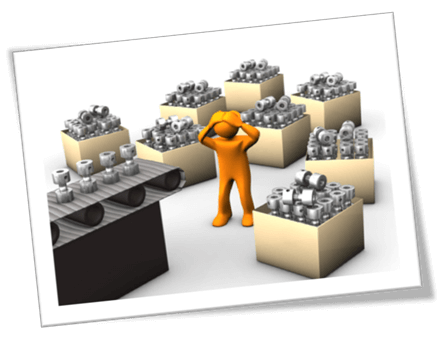
As discussed in Part 1, the first “O” has caveats associated with its inclusion on the list of wastes. Some view over production, to create finished goods, as a method to facilitate agility or reduce lead time to the customer. I call this deliberate over production and it doesn’t come without risk.
By definition, Over Production is clearly wasteful and defies the underlying principle of Lean, but over production is an absolute necessity; an end product is impossible to create without ensuring that over production is contained within the process. We call this make-ready or set-up.
Make-ready waste is inclusive to the point that it becomes part of the process. To some extent the waste is mitigated, as our Estimators have (hopefully) calculated it into the cost of the job. For non-Lean practitioners, the conversation ends there; “it’s not waste as the customer pays for it”, is the oft heard justification but for people of a Lean mindset, everything that doesn’t add value is waste and waste has a cost, regardless of who “pays” for it.
Many years ago, I had the honour of escorting Masaaki Imai, the legendary creator of Kaizen and the founder of the Kaizen Institute, around my plant in Saudi Arabia. As we walked around the print department, with the presses humming away at near maximum output, I turned to the eminent Mr Imai and, with uncharacteristic hubris, stated:
“impressive, yes?”, which elicited the droll response of,
“yes, very big warehouse”
Obviously, he was right. The work invested into making the presses efficient had resulted in over production; it had created a “push” system and created false bottlenecks. By looking at only one aspect of the process I had set up a wasteful, non-value production stream.
It would be churlish to argue that the production was a work in progress, even if that’s what I felt at the time, because I was not taking an holistic view of my production platform. Seeing the process, literally, as a stream, allows one to see the big picture and anticipate wasteful steps of over production.
(c) Medium
As mentioned earlier, the caveat of the “O” waste is deliberate over production and, while it can have its benefits, it is fraught with RISK. I don’t have many, if any, positive experiences with deliberate over production, I have found that it can only work within a very limited timeframe, a maximum of weeks, yet I have experienced businesses pursuing this perilous model over years.
In a recent assignment I found that over production was the accepted norm, yet customers were complaining of unworkable, extended lead times, a contradiction of Lean principles. Changing the model to eliminate over production brought the plant to an acceptable performance level; identifying waste in the process created capacity, eased bottlenecks and improved flow.
Veering off topic, slightly, I remember an over excited Sales Director, after gaining his first, small order with the former music behemoth, EMI, taking a “calculated risk” and demanding that production print sufficient paper to produce a million, finished CD booklets of the soundtrack for an Oscar winning movie. By the time the second order came in, the record company had changed the artwork…
If deliberate over production is your business model then it should be strictly controlled, short term and mitigated through mutual agreement.
OVER PROCESSING
(c) SlidePlayer
As Shingeo Shingo rightly surmised; “It’s only the last turn of the bolt that tightens it – the rest is just movement”.
I suppose, for the benefits of this “O”, we could continue with, “and only the wasteful continue turning it”.
The first example that sprang to mind when writing this section was in pre-production. I have lost count of the number of businesses that have used proprietary ERP/MIS systems and then decided that their process needed something outside of that system. Performing the same or similar tasks in different locations is over processing and can lead to significant delays further down the value stream.
An excellent method to identify waste in pre-production is by using the Value Stream Mapping (VSM) tool. In essence, VSM identifies where your process is now (known as current state) and calculates what the TAKT, or ideal, time should be for each action in the operation (future state). The VSM model incorporates the whole production flow, from order intake to dispatch but I would recommend taking implementation step by step. While the entire flow of the value stream needs to be understood, efforts at improving TAKT will be more efficient if focused at the beginning of the process and then reassessing, comprehensively, after each improvement. In Lean terms we refer to this as PDCA. Plan, Do, Check, Act.
(c) Medium
Over processing in the production cycle takes many forms. In the section on “Transport” I anecdotally write about relocating the plate making department, which subsequently eliminated plate damage, resulting in significantly fewer plates being processed. That is an example of over processing due to external factors but over processing because of the incumbent methodology is often overlooked, as it is an accepted part of how the system works (the “we’ve always done it like that” philosophy, as espoused by the alumni of Luddite University).
Over my career I have visited innumerable print and packaging plants and what often fascinates me is the waste “invested” in quality, now this might seem a contradiction in terms but please, bear with me.
Firstly, I am an advocate of quality for everyone. Every employee has a direct responsibility for the quality of the product that leaves their site but quality needs to improve the process flow, not suppress or stop it.
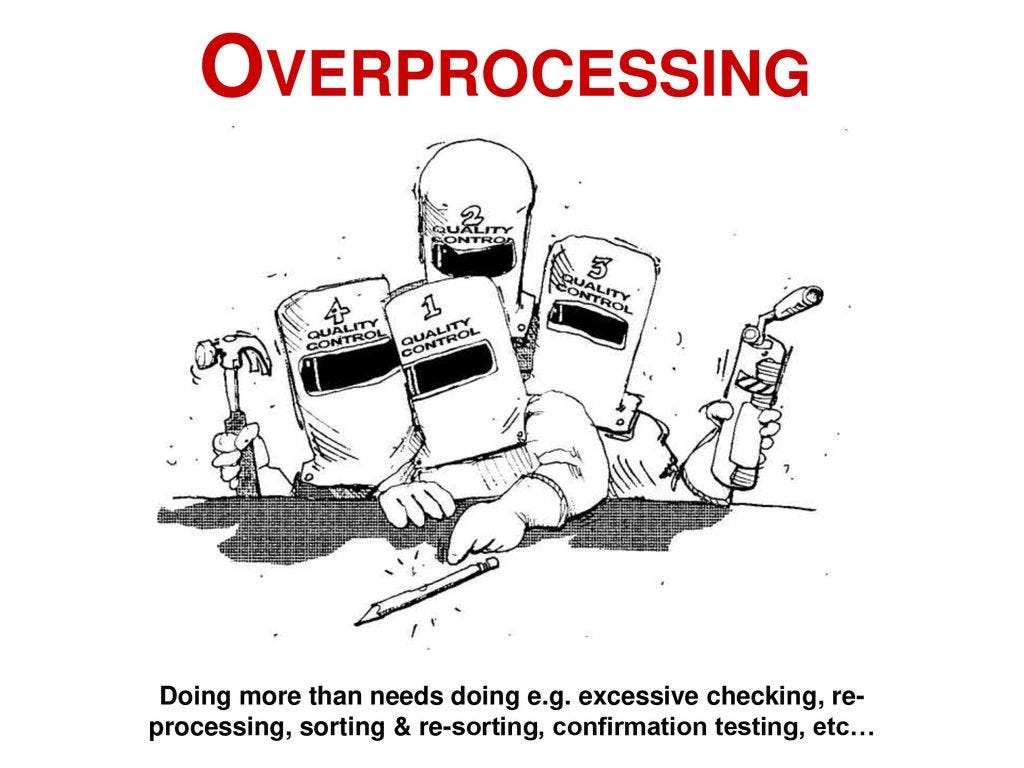
Analysing inspection points and asking “why are you doing that?” is an entirely appropriate method of determining over processing, on the basis that if the inspection isn’t justified, it is waste. If, by asking further “why’s”, the answer is that there was a problem; there’s a problem, a waste problem.
Now, without me even getting on my quality soapbox, I can state, for the record, that in 99% of cases, this is over processing and is wasteful. If you don’t agree with me, go take a look through your production operation today and ask the “why are you...?” question and see if that inspection is still relevant.
In “D” I will discuss Defect and one particular philosophy that sprang from the zero-defect school of thinking that has relevance in over processing. RFT (or FTR, dependent on when one studied Six Sigma) is an acronym for Right First Time and is a sub-topic that I would recommend reading to help with one’s Lean mindset.
As always, the articles are intended to be an introduction to the topics on hand and not a comprehensive guide to the subject, that would take too much time and a book, not a column. If you have a specific point that you would like to discuss, feel free to make contact.
© Andrew Malson is a highly experienced, committed and passionate Operations Executive/Director/Manager with a demonstrable reputation for creating the change required to deliver significant improvements in business performance through quality, service and productivity. He has invaluable strength in establishing and ensuring sustainable success of single, multi, and regional manufacturing sites by creating right and enduring cultural change through involvement and development of people. In the 30 years since beginning in the industry, Andrew has been responsible for the design and implementation of systems covering quality, people development, environmental standards and operational excellence. He brought his wealth of experience and invaluable knowledge to bear at WHERE To Print magazine in West Africa in its quest to positively influence and improve print purchase decisions with special focus on Lean Manufacturing Implementation; Organisational Effectiveness; and Sustainable Business Growth. Andrew welcomes your connection via wheretoprint@yahoo.com or directly vide andrewcmalson@gmail.com
NB: Information on joju.substack.com is mostly adapted or culled from press releases or supporting affiliates’ contents and are thus copyright materials. These are not in any way the personal thought, opinion or view of the Publisher.